Phantom hacker scams: when fake tech support, a fake bank and a fake agency tell you to move your savings
A hacker who does not exist
The "phantom hacker" scam is a three-step con that chains together several impersonators. The FBI's Internet Crime Complaint Center warned about it in a September 29, 2023 public service announcement, saying that senior citizens are the primary targets and that scammers use layered personas to build trust and find high-value accounts. In the end, no hacker existed. The only thief is the person on the phone.
The FBI's figures show the scale. For January through June 2023, it reported more than $542 million in losses from about 19,000 tech support scam complaints. Nearly half of reporting victims were over 60, and that group accounted for 66% of total losses. By August 2023, losses had already passed the 2022 total by 40%.
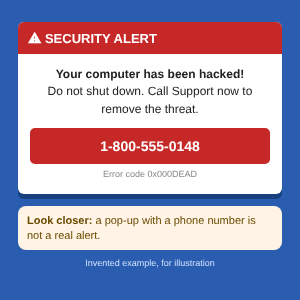 Invented example, for illustration: a pop-up that tells you to call a phone number.
Phase one: tech support
It begins with a scammer posing as tech support, reaching you by call, text, email or a pop-up. You are persuaded to call and download software that gives them remote access to your computer. They run a fake virus scan, claim to find a hacking risk, and ask you to open your financial accounts "to identify the problem", which helps them choose the most valuable account to target.
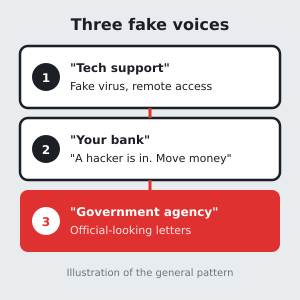 The three impersonators scammers use, one after the other.
Phase two: your "bank"
Next, someone posing as your bank or brokerage says a foreign hacker has accessed your accounts. You are told to move your money to a "safe" third-party account, often by wire, cash or cryptocurrency, sometimes overseas and across several transactions over days or months. You are also told not to tell anyone.
Phase three: the "government"
If you grow suspicious, a third voice appears, claiming to be from the Federal Reserve or another government agency. The FBI says this scammer may send official-looking letters or emails to reassure you, and insists the funds are still unsafe and must be moved to a new "alias" account.
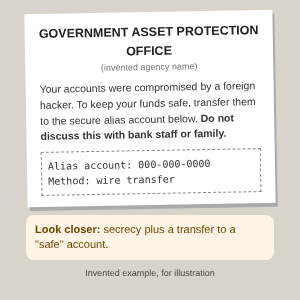 Invented example, for illustration: a letter that demands secrecy and a transfer.
How to protect yourself
The FBI's advice is direct. Do not click unsolicited pop-ups, text links, or email links and attachments. Do not call phone numbers given in them. Do not download software at the request of an unknown contact, and never let an unknown person control your computer. The U.S. government will never ask for wire transfers to foreign accounts, cryptocurrency, or gift or prepaid cards.
Fraud.org adds a useful principle: do not move money to "protect" it. If a threat were real, your money is usually safest in its regular FDIC-insured account. Verify any claim by hanging up and calling your bank at a number you know is legitimate. Secrecy is a red flag in its own right, so tell a family member or friend whenever someone asks you to keep a money matter secret.
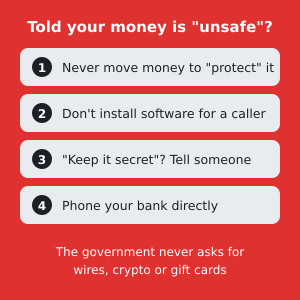 A quick checklist if anyone says your money is unsafe.
- Stop all contact and disconnect the computer from the internet. Do not let anyone connect to it again.
- Call your bank right away, using a number from your card or statement, and ask it to try to stop or recall the transfers.
- Report to your local FBI field office and to ic3.gov, including the contact's name, how they reached you, and any recipient account numbers and names.
- Have the computer checked by someone you trust, and change your passwords from a clean device.
- FBI IC3, "Phantom Hacker" scams target senior citizens and result in victims losing their life savings (September 29, 2023)
- FBI Denver, FBI Denver warns of "Phantom Hacker" financial scam
- Fraud.org (National Consumers League), Phantom hacker scams have caused significant losses for older individuals