Gift Card Scams: Why Anyone Who Asks You to Pay With Gift Cards Is a Scammer
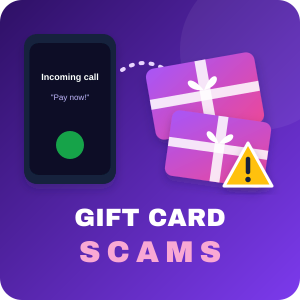 A phone call, a demand and a stack of gift cards.
The Payment Method No Honest Business Uses
Gift cards exist for one reason: to be given as presents. They are not a way of paying taxes, settling a debt, clearing a legal problem or protecting your savings. Yet they have become one of the favourite ways for criminals to get paid, and the US Federal Trade Commission says that gift cards have been the most frequently reported payment method in fraud complaints every year since 2018.
The rule that follows is blunt, and the FTC states it plainly: anyone who demands payment by gift card is a scammer. Government agencies and legitimate businesses simply do not ask for it.
Four Voices, One Request
The caller's story changes, but the ending never does. Most of these scams begin with a phone call from someone claiming to be from a well-known company or a government agency, such as Amazon, Apple or the Social Security Administration. You might be told your account has been compromised, that you are about to be arrested, or that your bank balance needs to be moved somewhere safe.
The same demand turns up in other disguises. The FTC also describes romantic partners who need help, employers who ask you to buy cards for work, sweepstakes companies that say you must pay a fee to collect a prize, and relatives who are supposedly in trouble. In every version, the solution to the emergency is to buy gift cards.
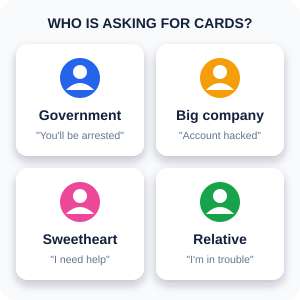 The disguise changes. The demand does not.
Kept on the Line While You Shop
What makes the scam so effective is that it controls you in real time. According to the FTC, victims are commonly told to stay on the phone while they go to a shop, and the caller coaches them on what to say to the cashier. Some are sent from store to store, buying more cards each time.
The constant presence of a "helpful" voice leaves no room for a second opinion. Nobody can phone a friend, look something up or simply sleep on it. By the time the cards are bought, the caller asks for the numbers on the back, often described as a "security code", and the money is gone as soon as they are read out.
Why Plastic Beats Cash for Criminals
A gift card number is a kind of cash that can be spent from anywhere. Once a scammer has the number and the PIN, they do not need the card itself, and they never have to meet the victim. That is why the details are what they want, and why a photo of the card or a number read over the phone can be as good as handing it over.
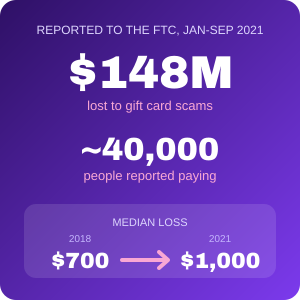 FTC figures for January to September 2021, the latest full set it published.
What the Reports Reveal
The scale is considerable. The FTC reported that in the first nine months of 2021, nearly 40,000 people told it they had paid scammers with gift cards, with reported losses of about $148 million, more than for the whole of 2020. It also noted that these numbers are probably only a fraction of the real harm, since most fraud is never reported.
The typical loss has risen too. The median reported loss climbed from $700 in 2018 to $1,000 in 2021, and the share of victims losing $5,000 or more increased from about 8 per cent to roughly 14 per cent. Target cards were the most commonly used brand by far, followed by Google Play, Apple, eBay and Walmart.
Hearing the Script as It Runs
Once you know the pattern, the call sounds different. There is always a deadline, a threat or a secret, such as an arrest that can only be avoided today or a "security" matter that you must not discuss with the bank. The caller discourages you from hanging up, and the instructions about which shops and which brands to use are oddly specific. A real agency would send a letter, give you time and let you ask questions, while a scammer cannot afford for you to stop and think.
If You Have Already Paid
Act at once. Keep the gift card and the receipt, then contact the company that issued the card and tell them it was used in a scam. The FTC advises reporting the incident to the card issuer and to ReportFraud.ftc.gov, and its guidance on contacting gift card companies is at ftc.gov/giftcards. Speed matters, because the money can only be stopped while it has not been spent.
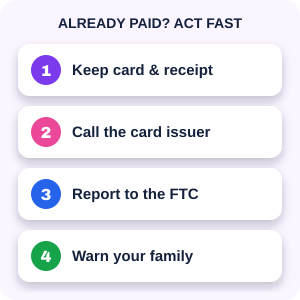 The first hour after a payment is the most important.
Talk to the Cashier and the Family
Shop staff can be an unexpected line of defence. The FTC offers materials that help retailers train employees to spot customers who may be buying cards for a scam, and if you are buying several cards while someone on the phone tells you what to do, a friendly cashier may be the one who stops you.
At home, a quick chat can help older relatives as much as any warning. Explain that no genuine caller will ever ask them to buy gift cards, and agree that anyone who does can be hung up on, no matter how official they sound.