Car Wrap Scams: Why Getting Paid to Advertise on Your Car Often Ends With a Bounced Check
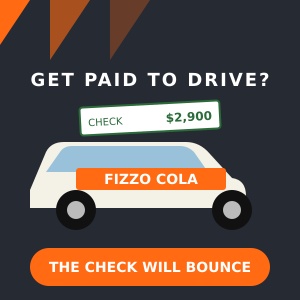 The wrap never happens. The check is the whole trick.
Paid to Drive Around With an Ad
AARP describes the offer: you are paid to wrap your car, boat or even bicycle in advertising for a well-known brand, with roughly $400 a week promised. It arrives by text, email or a website with an "application" form. The Massachusetts Office of Consumer Affairs notes that scammers pose as a real company and use its logo, and one example offered $700 a week for a soda wrap. Applicants are often students or job seekers, and the BBB says the pandemic contributed to an uptick, though the scam can target people of any age.
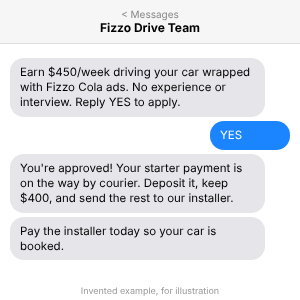 Invented example, for illustration: easy pay, no interview and a check on the way.
The Cashier's Check That Looks Real
After you apply, a "boss" mails you a cashier's check, typically for a few thousand dollars, and tells you to deposit it. You are asked to keep a share and send the rest, often through a payment app such as Venmo or Cash App, to a local "vendor" or "technician" who will do the wrapping. In AARP's example, a man received a $1,850.45 check and was told to forward $1,450; in a BBB report, a victim sent $3,500 and then waited two days for a wrap that never came.
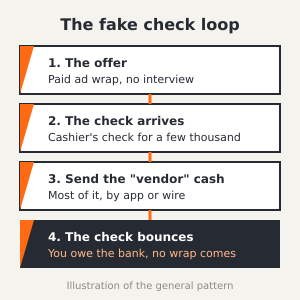 The loop that leaves you owing the bank.
Why "Funds Available" Is Not Proof
The BBB explains that banks make deposited funds available before a check has actually cleared. The money may show in your balance, you spend or send it, and then the bank finds the check is counterfeit. You must repay the full amount, perhaps with overdraft fees, while the scammer keeps what you sent and disappears. Wire and app transfers are hard to trace, so the money is usually lost for good. The BBB suggests waiting about 30 days before spending money from a questionable check.
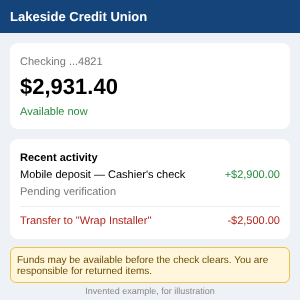 Invented example, for illustration: a pending deposit, an available balance and a transfer out.
Signs the Offer Is Fake
Warning signs include an unsolicited offer, an application asking for a date of birth and bank details, awkward phrasing and grammar, and sender locations that do not match, such as a check mailed from one state, drawn on a credit union in another and with texts from a third. Legitimate employers want to talk with candidates first, and the Massachusetts office stresses that a real company never asks you to wire money. Keurig Dr Pepper told AARP it runs no such wrapping program, and Massachusetts advises checking whether a job is really posted and applying only on the company's own website.
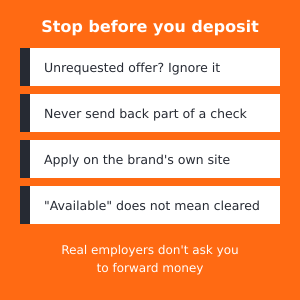 Four rules before you deposit.
- Stop sending money and tell your bank right away; ask what happens to the deposit.
- Keep every text, email and receipt as records.
- Report it to the FTC at ReportFraud.ftc.gov, to BBB Scam Tracker, and to local law enforcement.
- If a brand is being impersonated, tell the real company so it can warn others.