Social Security Scams: Why Your Number Cannot Be Suspended and Who Will Never Call to Say It Was
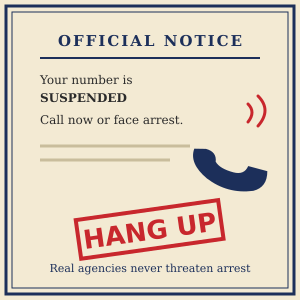 An official tone does not make a call official.
Your Number Has Been Suspended
The caller sounds calm and serious. Your Social Security number, they say, has been linked to a crime or suspended because of suspicious activity, and you need to act at once to protect yourself. They may quote a badge number and the name of a real official. The Social Security Administration's Office of the Inspector General says scammers use names of real SSA and OIG officials, which are often public on agency websites, and cite fake law enforcement "badge numbers" to seem official.
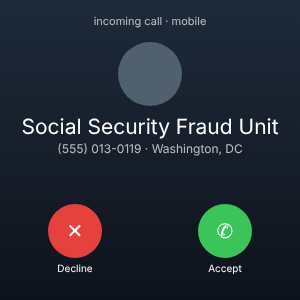 An invented example: caller ID can be faked to show any name.
Something Your Number Cannot Do
A Social Security number cannot be suspended because someone else used it in a crime. The agency's inspector general lists a short set of things SSA will never do, which makes a good test for any suspicious call.
- suspend your Social Security number because it was used in a crime
- threaten arrest or legal action unless you pay immediately
- demand payment by gift card, wire transfer, internet currency or cash in the mail
- promise a benefit increase or other help in exchange for payment
- send official letters or reports containing your personal information by email
The Call That Gets "Transferred"
A newer version starts somewhere else. In a July 2026 alert, the OIG describes scammers who pose as a retailer, a bank, another agency or the police, often about a purchase or fraud you did not make. They then claim to transfer you to Social Security or the OIG, where a fake representative says your number was compromised, tied to identity theft or used in a crime. The OIG is clear that legitimate companies and other agencies cannot transfer your call directly to SSA or the OIG. Any call connected that way is a scam.
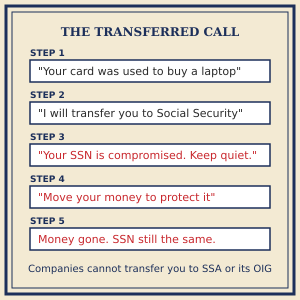 Each step builds on the one before it.
Keep This Between Us
The fake representative asks you to keep the call confidential, and demands your Social Security number, financial details or access to your device. Some ask for payment for a "new" number, or tell you to move your money somewhere "safe". One reported case involved a long document and a promise of a new Social Security number. The secrecy is a trap in itself, because it stops you from talking to someone who would say "that cannot be right".
Texts, Emails and Official-Looking Papers
Phone calls are not the only route. The OIG also warns about emails with attached "investigation" documents that contain personal information, and about texts with links to "learn more" about a supposed Social Security problem. Those links lead to look-alike pages that collect your details.
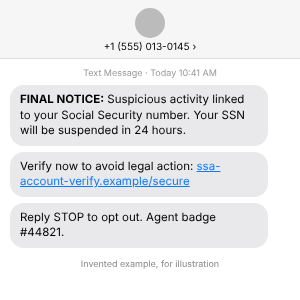 An invented example: a deadline, a threat and a link.
The Wider Picture
The FTC reported in June 2026 that people lost about $3.5 billion to imposter scams in 2025, with reported losses nearly tripling since 2020. Imposter scams were the most reported fraud category, with nearly one in three fraud reports concerning them. The FTC notes that one costly pattern starts with a fake security alert and pressure to move money to "protect" it, so losses are often limited only by the funds a victim has.
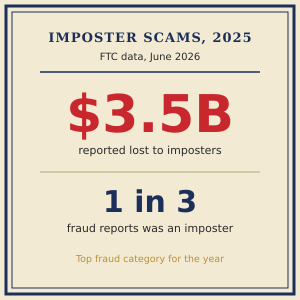 FTC data published June 2026.
Hanging Up Is the Strategy
The inspector general's advice is simple: do not believe anyone who calls you unsolicited from a government agency and threatens you, just hang up. Do not press any numbers or stay on the line, and do not trust caller ID, since scammers can spoof government numbers. If you actually owe SSA money, it will send a letter describing payment options and appeal rights. To check, contact the agency using a number you look up yourself.
If You Already Shared Something
Call your bank or retailer directly about any suspicious charges, and change the login details for any account that may be exposed. Report the scam at ssa.gov/scam or oig.ssa.gov, and to the FTC at ReportFraud.ftc.gov.
- SSA Office of the Inspector General, Warning issued for widespread Social Security phone scams
- SSA Office of the Inspector General, Beware of fake call transfers to Social Security or OIG (July 29, 2026)
- US Federal Trade Commission, FTC data show people reported losing $3.5 billion to imposter scams in 2025 (June 2026)