Payment App Scams: How Zelle, Venmo and Cash App Fraud Empties Your Account
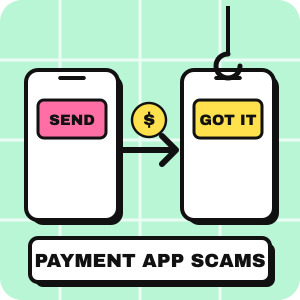 Money moves instantly, and so does the trap.
Money That Moves Faster Than Second Thoughts
Apps such as Zelle, Venmo, PayPal and Cash App have made it easy to split a restaurant bill or pay a babysitter in seconds. That speed is exactly why criminals like them. AARP explains that these person-to-person transfers are nearly instant, usually cannot be cancelled, and do not come with the protections that credit cards offer. In practical terms, sending money this way is much like handing over cash.
Scammers do not need to break into anything. They only need you to press "send" yourself, and they have several ways of making that feel like the right thing to do.
The "Sent by Mistake" Trick
Imagine a stranger sends you a payment, then writes to say it was a mistake and asks for the money back. Oregon's Division of Financial Regulation warns that this is a well-known scam. If you send the amount back as a new payment, the original transfer may later be reversed, perhaps because it was made with stolen financial details, and you are left out of pocket.
The safest response is not to reply at all. If an unexpected payment appears, contact your bank or the app through its official channels and let them handle the return.
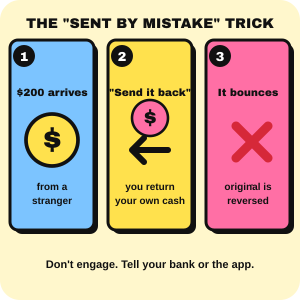 You send your own money back, and the original disappears.
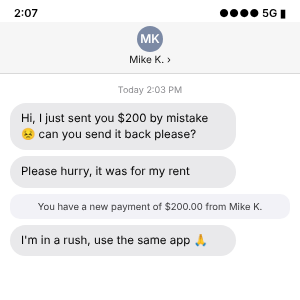 An invented example of the message. Real wording varies.
A Call From "Your Bank" About Your Own Account
One of the most convincing versions begins with an email or text about a payment you never made. A few minutes later your phone rings, and the number on the screen looks like your bank's. The "fraud officer" says that your account is under attack and that you must move your money to a safe account at once. The US Office of the Comptroller of the Currency describes exactly this pattern, including a tactic of asking victims to "reverse" a payment by sending money.
Here the account that receives your money belongs to the scammer. The OCC points out that a bank will never ask you to send money to yourself through a payment app. Before sending money to an account of your own at another bank, confirm that the email address or phone number is genuinely enrolled and linked to it.
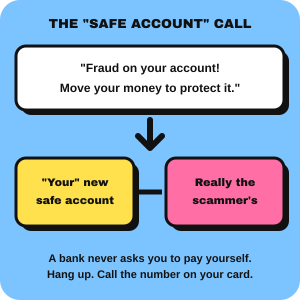 The "safe account" is the scammer's account.
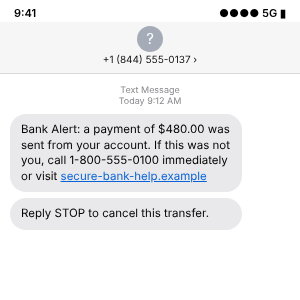 An invented example of a fake alert. Never call a number from a text.
Fake Sellers, Fake Support and Fake Friends
The same apps are used in smaller, quieter schemes. A seller advertises a puppy or a gadget and asks for a deposit through Cash App or Google Pay, then vanishes. Someone posing as customer support says your account is at risk and asks for the code that was just texted to you, which is how they take it over. A profile that copies the photo of your friend, landlord or employer asks for a quick favour.
AARP adds a similar example: a person who sent money to a friend whose WhatsApp account had been hacked. A useful habit is to check any request by calling the real person on a number you already have, and to be cautious of accounts that are new and have little history. Legitimate support staff do not ask for your texted verification code.
Why Getting the Money Back Is So Difficult
Whether a bank reimburses you often depends on one word: authorised. AARP notes that if your account was hacked and the payment was unauthorised, you are more likely to be reimbursed, but if you sent the money yourself, even because you were tricked, the answer is usually no. Zelle says it also covers some impostor scams, though it has not clearly said which ones, so it is worth asking your bank about its policy.
The scale of the problem has been argued over. A December 2024 complaint from the US Consumer Financial Protection Bureau claimed that more than $870 million had been lost on Zelle since 2017, though the bureau dropped that case in March 2025. A July 2024 US Senate subcommittee report found that three large banks reimbursed fraud victims in 38 per cent of cases in 2023. Zelle says its practices have changed since then.
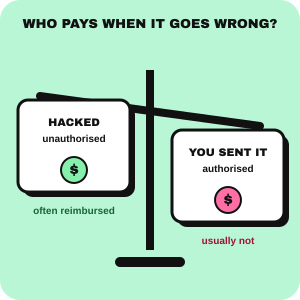 Whether you can recover money often depends on who "authorised" it.
Small Habits That Keep Your Money at Home
Treat every payment app transfer as cash and ask yourself whether you would hand this person banknotes. Use these apps only with people you know, and be wary of a business that accepts nothing except app payments. For unfamiliar sellers, a credit card, ideally with a one-time number, gives you far more protection. When an app warns that you are paying someone for the first time, take it seriously and pause.
After a Bad Payment
Contact your bank or credit union straight away, using the number on your card or the app's official help pages rather than one from a search result, as fake support sites are common. Change your passwords, turn on transaction alerts, and file a police report and a complaint at ReportFraud.ftc.gov. Expect another approach, too: AARP warns that "fund recovery" services that contact you afterwards are often scammers hunting for a second payment.