Medicare Impersonation Scam
1A caller who sounds like the help you need
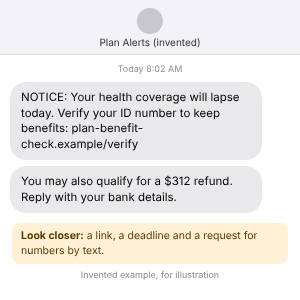
Choosing or keeping health coverage is confusing, so a friendly "representative" can sound welcome. The FTC warned in an October 13, 2023 alert that scammers look official and pretend to be from Medicare, connected to it, or from a business you know. They may reach you by phone, mail, email, social media or text, use the Medicare name or sound government-like, and ask for your Medicare, Social Security or financial account numbers.
The FTC states that Medicare does not call unexpectedly to sell insurance or to request your Medicare number or financial information. In a November 18, 2024 alert it added that a caller ID showing Medicare's name or number can be faked.
2What they say, and what is true
A Washington State Office of the Insurance Commissioner fact sheet (October 2025), produced by its SHIBA program, lists seven common schemes during Open Enrollment. Four of them are easy to check against the facts it gives.
| The fake representative says | The fact sheet says |
|---|---|
| "New cards are on the way." | New Medicare numbers were issued in 2018 and there are no plans to reissue cards. |
| "Your coverage ends tonight. Verify your ID." | This is a pretext to collect your Medicare number, birth date, Social Security number or bank details. |
| "You are preapproved for a better, cheaper plan." | The offer is used to harvest information, and the plan may not cover your doctors, prescriptions or care. |
| "Medicare prefers this plan." | Medicare and Medicaid do not endorse plans. |
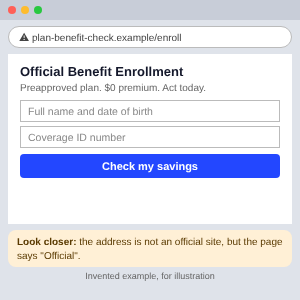
The other three schemes on the list are overpayment refunds that are really aimed at your banking information, free braces or genetic tests used to get your Medicare ID, and spoof websites that collect your name, address, birth date and Medicare ID and may redirect you to sites operated outside the U.S.
3What they are after
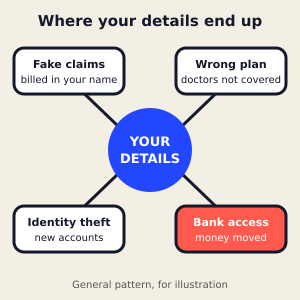
The aim is information. A name, birth date, coverage ID, Social Security number or bank detail can be used to bill for services that were never provided, to switch you to a plan you did not choose, or to commit identity theft. The Washington fact sheet calls out the risk that a "better" plan may leave you without coverage for your own doctors or medicines, which is a harm even when no money changes hands.
4Red flags to remember
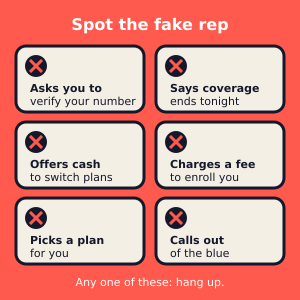
The same fact sheet lists these warning signs. Any one of them is a reason to end the conversation.
- An unsolicited call asking for your Medicare number or other ID.
- Anyone offering cash or gifts to switch plans.
- Anyone charging a fee to enroll you in a plan.
- High-pressure sales tactics, or an agent choosing a plan for you.
- An offer that seems too good to be true.
- Medicare calling to verify or update your number or to enroll you in a plan, which it does not do.
5How to check, and who to call
Do not share personal information with unsolicited contacts. If you are unsure, hang up and call Medicare directly at 1-800-MEDICARE (1-800-633-4227), and do not click links, open attachments or call numbers in suspicious messages. For plan comparisons, the FTC suggests contacting your State Health Insurance Assistance Program (SHIP). The Washington fact sheet adds that before accepting a plan you should confirm it covers your doctors and pharmacies, and that free supplies on Original Medicare require a doctor's prescription and a Medicare-contracted supplier. Be careful with enrollment links and make sure you reach the official site.
6If you already shared your details
- Hang up, then call 1-800-MEDICARE (1-800-633-4227) and say what you shared.
- Contact your State Health Insurance Assistance Program or Senior Medicare Patrol (smpresource.org) for help.
- If you gave bank details, call your bank on a number you know and watch your accounts.
- Report the scam to the FTC at ReportFraud.ftc.gov.
- FTC Consumer Alert, How to avoid Medicare Open Enrollment scams (October 13, 2023)
- FTC Consumer Alert, Avoid scams during Medicare's Open Enrollment Period (November 18, 2024)
- Washington State Office of the Insurance Commissioner (SHIBA), Seven common fraud schemes during Medicare Open Enrollment (October 2025)