Check Washing Scam
A paper check is a risky thing to mail
A personal check carries your name, address, bank and account details, and a signature. If it is stolen, it can be turned into cash. The FBI and the U.S. Postal Inspection Service (USPIS) warned in a January 27, 2025 public service announcement that check fraud linked to mail theft is on the rise, and that suspicious activity reports for check fraud nearly doubled between 2021 and 2023.
FinCEN, in coordination with USPIS, reported similar numbers in a February 27, 2023 alert: more than 350,000 check fraud reports in 2021, a 23% increase over 2020, and more than 680,000 in 2022. It also noted that criminals steal personal, business, tax refund and government assistance checks.
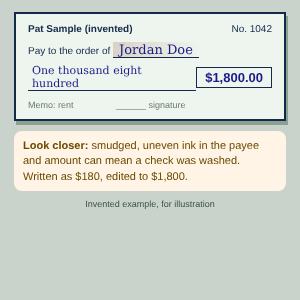 Invented example, for illustration: uneven ink and a changed payee and amount.
How the checks are stolen
According to the FBI and USPIS, checks are taken from residential mailboxes left full overnight or for long periods, and from blue collection boxes after the last pickup. They can also be stolen in burglaries of postal facilities, robberies of postal employees, through bribery or collusion with employees, or during delivery to the person they were meant for.
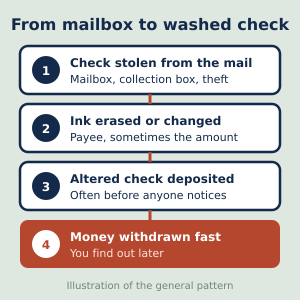 The usual sequence, from the mailbox to the bank account.
Washing, and "cooking"
Check washing means using chemicals to change the payee and the amount on the original check. A related method, check "cooking", edits the image of a stolen check digitally and prints it, often as several checks for smaller amounts that are less likely to draw attention. Some stolen checks are not altered at all and are deposited with forged endorsements.
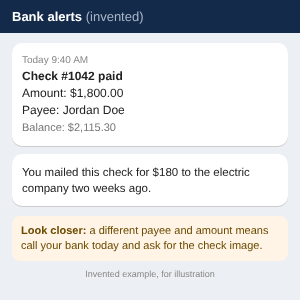 Invented example, for illustration: a bank alert that does not match what you mailed.
Cashing in before anyone notices
The altered check then has to be deposited. The FBI and USPIS say a collusive account holder may be recruited to deposit it, or the stolen checks may be sold online for a fraction of their face value. Banks must make deposited funds available within set timeframes, and that window is often too short to catch the fraud, so the money can be withdrawn before the real account holder or the bank notices. FinCEN adds that information in stolen mail can fuel further fraud, such as credit card or credit account fraud.
Protecting your mail and your checks
The FBI and USPIS advise picking up mail promptly instead of leaving it in the mailbox, using USPS Hold Mail when traveling, and signing up for Informed Delivery. They also suggest dropping mail inside the Post Office or into a blue box as close to the pickup time as possible, following up with senders when an expected check does not arrive, and considering security envelopes.
For the check itself, use indelible black ink, leave no blank spaces on the payee or amount lines, and do not print details like your Social Security number or phone number on checks. Monitor your account through online or mobile banking, consider electronic payments, use positive pay if your bank offers it, and choose checks with security features.
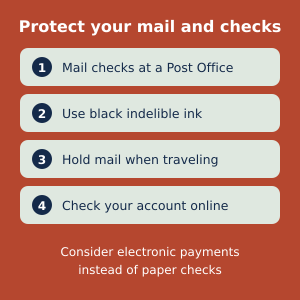 Simple habits that make mailed checks harder to steal.
- Contact your bank immediately and ask for copies of the fraudulent checks. Consider opening a new account and closing the compromised one.
- Report it to the FBI's Internet Crime Complaint Center at ic3.gov.
- For mail theft, also report to your local police and to USPIS at uspis.gov/report or 1-877-876-2455.