Deepfake Investment Scams: When a Famous Face in an Ad Is Not Who It Seems
 The face on the screen may be real. The endorsement is not.
A Famous Face Tells You How to Get Rich
A video ad appears in your feed. A well-known businessperson or celebrity is speaking calmly to the camera about an investment platform that, they say, can turn a few hundred dollars into thousands. It looks and sounds real. The FTC warns that scammers create fake celebrity and influencer endorsements, sometimes with doctored video and audio, and that the fakes are getting more convincing as the technology improves.
How the Fake Gets Made
New York's Attorney General explained in an August 2024 investor alert that scammers use AI to alter existing videos so that famous figures appear to endorse investment schemes, often involving cryptocurrency. The manipulated clips turn up as social media ads, digital ads, messaging app posts and even fake livestreams on video platforms. Some scammers instead pose as government officials or other trusted people.
 An invented example: a "live" video, big profits and a sign-up button.
From the Ad to a Private Chat
The ad is only the opening. According to the New York alert, victims are moved to encrypted messaging apps, shown fake websites reporting gains, and pressed to invest more. A request to leave the public platform and continue in private is one of the listed warning signs, along with guaranteed returns, pressure to invest immediately and requests to send crypto to an unlicensed platform or private wallet.
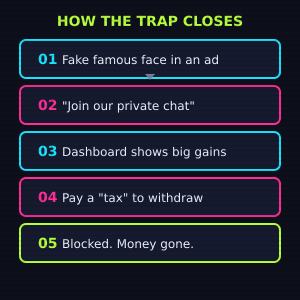 Each step is designed to make the next payment feel reasonable.
The Dashboard That Shows Money That Does Not Exist
Inside the platform, the balance grows. The numbers are fake, but they build confidence. When victims try to withdraw, the New York alert says, they are blocked or asked for extra fees or "taxes". Later, fake recovery services may contact them again, a pattern the FBI also warns about.
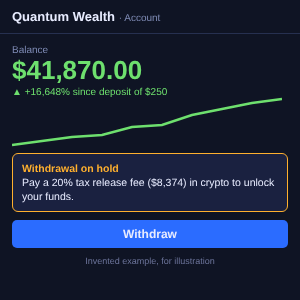 An invented example: huge gains on screen and a fee to withdraw.
What the FBI Is Counting
The FBI's Internet Crime Complaint Center reported in its 2025 annual report 22,364 complaints that had an AI-related descriptor, with $893 million in adjusted losses. It was the first year the report had a dedicated AI section, and the figure is a floor, since AI is only counted when victims recognized it. Investment fraud accounted for $632 million of the AI-linked losses.
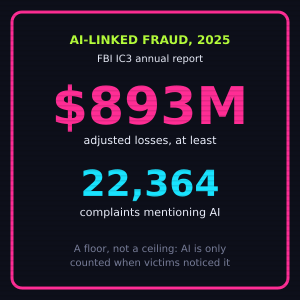 FBI IC3 2025 report, as summarized by SecureWorld (April 2026).
Checking an Endorsement Before You Trust It
The FTC's advice is to search the celebrity or influencer's name together with the product or company and words like "scam" or "fake". Be wary of pressure to buy immediately and of investment pitches promising high earnings with little or no risk. The FTC reminds readers that investments always involve risk and that no investment guarantees returns. New York's Attorney General adds that you should treat livestreams and video messages urging investment with suspicion and reverse-search the footage to check where it came from.
Verifying the Seller
Research the salesperson, check their address and verify their registration with FINRA BrokerCheck. The FTC points to Investor.gov, the SEC's website, for guidance on avoiding investment fraud. Never share personal, financial or login details with someone you have only met online, confirm offers from known contacts through a different channel such as a phone call, and turn on multi-factor authentication for your financial and email accounts.
If You Have Already Sent Money
Keep every record and message, because these transactions are usually irreversible. Report the fake endorsement to the FTC at ReportFraud.ftc.gov, and report the loss to the FBI at ic3.gov. In New York, victims can also call 1-800-771-7755. Be ready for follow-up approaches from people offering to recover your money for a fee, because those are scams too.