Voice Cloning Scams: When a Fake Family Member Calls for Money
The Call You Hope You Never Get
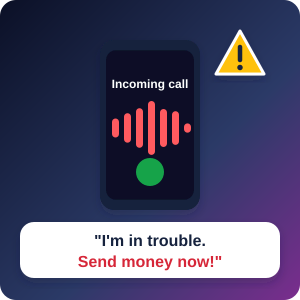
Picture the phone ringing late in the evening. The voice on the other end is crying, out of breath and clearly frightened, and it sounds exactly like your grandson, your daughter or your younger brother. There has been an accident, or an arrest, or some other emergency, and they need money immediately. Every instinct tells you to help first and ask questions later, and that is precisely the reaction the person on the line is counting on.
Family emergency scams are not new, and for years they depended on a caller mumbling "Grandma, it's me" and hoping the victim would supply a name. What has changed is the technology. Artificial intelligence can now copy the sound of a real person's voice, which removes the biggest weakness of the old scam: the voice no longer sounds wrong.
From a Few Seconds of Audio to a Convincing Fake
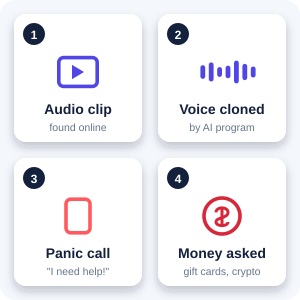
Voice-cloning software learns the pitch, accent and rhythm of a speaker from a recording and can then be made to say anything typed into it. The FBI's Internet Crime Complaint Center has warned that criminals use generative AI to produce this kind of audio, and the US Federal Trade Commission has noted that a short clip of someone's voice is enough for a cloning program to work with. That clip might come from a video on social media, a voicemail greeting or a recorded conference call.
Most of us leave far more of our voices online than we realise. A birthday video, a travel vlog or a public post with sound gives a scammer all the raw material required. The criminal still needs to find out who your relatives are, but family names and connections are often easy to see on public profiles.
Why Fear Beats Good Judgement
The scam is built around an emotional shock rather than a clever trick. The caller describes a crisis, such as a car crash, an arrest or a kidnapping, and insists that there is no time to explain. Often the story includes a reason why you cannot hang up and check, for example that the "relative" has lost their phone, is not allowed to talk for long, or must keep everything secret from the rest of the family.
This pressure is deliberate. A calm mind would notice odd details, but a frightened one focuses on a single goal, which is to make the problem go away. The cloned voice adds the final push, because hearing someone you love in distress is far more powerful than reading a suspicious message.
The more urgent and secretive the request, the more likely it is that someone does not want you to think. A useful rule of thumb for any unexpected call that asks for money
The Request That Gives the Game Away
Whatever story is told, the call ends in a request for money, and the method of payment is usually the clearest warning sign. Consumer protection agencies report that these scammers ask for wire transfers, cryptocurrency, or gift card numbers and PINs, because such payments are difficult to trace and almost impossible to reverse. Some fraudsters even send a courier to collect cash from the victim's door.
No genuine hospital, police station or lawyer will insist that a relative's emergency be settled with gift cards. If the conversation moves in that direction, the safest conclusion is that you are being targeted, no matter how real the voice seems.
Hang Up, Then Check
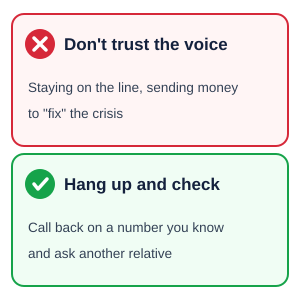
The single most effective defence is to end the call and contact the person yourself. Use the number you already have for them, not one provided by the caller, and if they do not answer, try another relative or a friend who might know where they are. In most cases you will discover within minutes that your loved one is safe and that the call was fabricated.
It helps to remember that a real emergency can wait sixty seconds for a callback, while a scam usually cannot. The FTC encourages people to take a "tactical pause" in these situations, and that short delay is often what breaks the spell.
A Family Password That Only Real Relatives Know
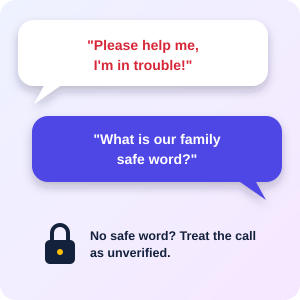
One of the simplest protections costs nothing at all. Agree on a secret word or phrase with the people closest to you, something that is not written on social media and cannot be guessed from a profile. The FBI recommends exactly this approach. If a caller claims to be a family member in trouble, ask for the word, and treat a missing or wrong answer as a serious red flag.
The idea works best when everyone, including older relatives, knows about it before an emergency happens. A short conversation at the dinner table about how these scams work can protect a grandparent far better than any technical tool.
Giving Scammers Less to Work With
You cannot stop every recording, but you can reduce the supply. The FTC and FBI suggest limiting how much of your voice and images are shared publicly, setting social media accounts to private and thinking twice before accepting friend requests from strangers. Listening carefully also helps, since cloned speech can still sound slightly flat, hesitant or oddly worded, and the caller may avoid answering personal questions that a real relative would find easy.
If You Already Sent Money
Act quickly. Contact your bank, card issuer or the payment service immediately and explain that the transfer was part of a scam, because speed gives the best chance of stopping or recovering a payment. If you paid with gift cards, tell the card company as well. Then report the incident to the authorities. In the United States you can do this at ReportFraud.ftc.gov, and the FBI's IC3 accepts reports of internet-enabled fraud. Elsewhere, use your national fraud reporting service.
Please do not feel embarrassed. These calls are designed by professionals to defeat sensible people, and reporting them helps investigators warn others.