Virtual Kidnapping Scams: When a Ransom Demand Uses Your Own Photos Against You
 The scam only works if you do not stop to check.
A Message No Parent Should Have to Read
Your phone buzzes with a text from an unknown number. Someone says they have taken your child, that you must not contact anyone, and that money has to be sent within minutes. A photo arrives to prove it. It is an alarming message, and it is exactly what the FBI calls a virtual kidnapping scam: criminals claim a loved one has been abducted, but no one has actually been taken. The only real victim is the person receiving the demand.
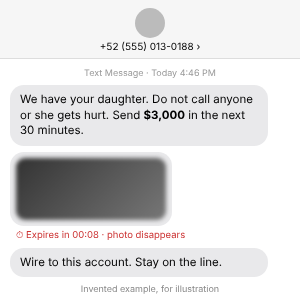 An invented example: a threat, a deadline and a photo that vanishes.
Proof of Life Made From Your Posts
In an alert dated December 5, 2025, the FBI's Internet Crime Complaint Center explained that scammers usually make contact by text and send a photo or video as "proof of life". The images are not real evidence. Criminals edit pictures taken from social media or other public sites to create the fake proof, and the FBI notes that close inspection often reveals flaws, such as a missing tattoo or scar or wrong body proportions.
Why the Photo Disappears
The FBI also warns that some scammers use self-deleting or timed messages. The point is to limit how long you can study the image. It is the same logic as the countdown in the demand: every second you spend looking, thinking or calling someone is a second in which the story could fall apart.
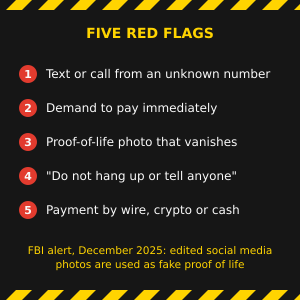 The same warning signs appear again and again.
The Phone Call Version
Not all of these are texts. An FBI field office warning describes calls in which the victim hears a woman crying or screaming in the background. The red flags it lists include calls from an outside area code, calls that do not come from the supposed victim's own phone, repeated calls, and callers who work hard to keep you on the line and prevent you from contacting the person. The ransom is typically requested only by wire transfer.
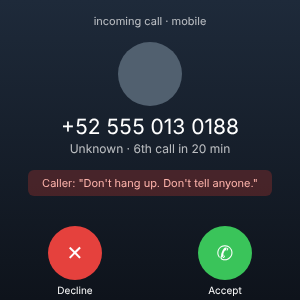 An invented example: repeated calls and an order not to hang up.
A Familiar Pressure Cooker
The FBI links this scam to older "emergency scams" such as the grandparent scam, with the difference that today's version adds fake images and sometimes AI tools. The core mechanism has not changed: panic, a deadline and secrecy. Once those are in place, the victim is cut off from anyone who might say "wait, that does not sound right".
Counting What Cannot Be Counted
The FBI Phoenix warning says the FBI does not keep national statistics on virtual kidnapping, and that most cases are believed to go unreported. Families, it notes, often send thousands of dollars before they contact law enforcement. The December 2025 alert gives no figures either, so this is a scam where you cannot rely on a headline number to judge how likely it is. What you can rely on is the pattern.
Slowing Down Is the Defense
The FBI's advice begins with a pause: assess whether the kidnapper's claims are logical, and try to contact the supposedly kidnapped person before paying any ransom. The earlier FBI warning adds practical steps, such as asking to speak to the victim directly, asking questions only the real person would know, having them call back from their own phone, and trying to reach them by text or social media.
- Stay calm and do not pay.
- Contact your loved one directly, or someone near them.
- Ask for a family code word or a question only they could answer.
- Call another relative, even if the caller told you to keep it secret.
- Contact the police, even if you suspect a scam.
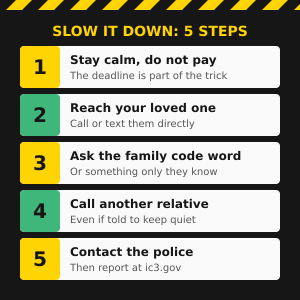 A pause is the most powerful tool you have.
What to Post and What to Share
The FBI recommends being cautious about what you post online about missing persons, since scammers may use that information, and not sharing personal details with strangers, especially while travelling. It also suggests that families agree on a code word known only to them, to verify any urgent communication. Screenshot or record any proof-of-life media before it disappears.
Reporting It
Report incidents to the FBI's Internet Crime Complaint Center at ic3.gov, including phone numbers, payment details, text and audio communications, and any proof-of-life images. If a real emergency seems possible, contact local police straight away.