Task Scams: Why You Should Never Pay to Get Paid for Online Jobs
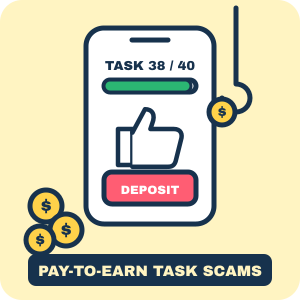 Do the tasks, then pay to keep going: the heart of the scam.
A Job Offer You Never Applied For
It usually begins with a message from nowhere. The US Federal Trade Commission says the contact comes by text, WhatsApp, Telegram or social media, and it is deliberately vague: an easy, flexible online job with decent pay. Nobody mentions a company, an interview or a contract, because there is no company behind it.
The FTC's advice on this point is simple. Legitimate employers do not recruit people with generic, unexpected texts, so such messages are best ignored.
 An invented example: an unknown number, big pay and no experience needed.
Likes, Ratings and "Product Boosting"
The work itself sounds almost too easy: liking videos, rating product images or "optimising" apps. The FTC reports that the scammers use phrases such as "product boosting" and "app optimization" to make the clicks sound like real business. Behind the jargon lies a point worth remembering. Paying someone to leave positive ratings or likes is illegal, and honest companies do not do it.
A Dashboard That Pays You in Pretend Money
As you work through the tasks, the app shows commissions rising with every click, and the balance looks impressive. The FTC points out that these earnings are fake. The numbers belong to a screen that the scammers control, and the money does not exist anywhere you can withdraw it.
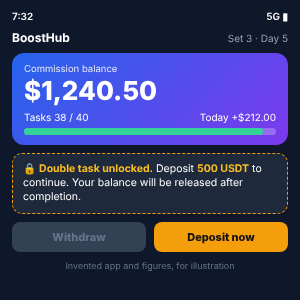 An invented example: a big balance, a locked withdrawal and a deposit button.
The First Few Dollars Are the Bait
To make the job feel genuine, scammers may send a small payment early on, typically between $5 and $20, according to the FTC. That small amount does a lot of work. It gives you proof that the job pays, and it turns doubt into confidence, which is exactly when the next request arrives.
Set Forty: The Deposit
The FTC's data spotlight explains that tasks come in sets of about forty. Just as you approach the end of a set, a "double task" appears with a promise of a larger commission, but it can only be unlocked by depositing your own money, often in cryptocurrency. Once the money is sent, it is gone, and the balance can never be withdrawn. Victims who deposit do not get their money back.
The Group Chat Full of Happy Workers
If you hesitate, the scammers may add you to a group chat in which other "workers" share their successes and screenshots of payouts. These people are part of the scheme. The FTC notes that this social pressure is used to nudge doubtful victims into depositing, so a crowd of cheerful strangers is not evidence of anything.
A Scam That Grew Almost Overnight
The numbers are striking. The FTC said in December 2024 that about 20,000 people reported task scams in the first half of that year, compared with about 5,000 in the whole of 2023. In the first half of 2024 task scams made up an estimated 38.8 per cent of all job scam reports, up from 5.6 per cent in 2023.
Reported losses to job scams in general rose from $90 million in 2020 to $286 million in 2023, and reached $223 million in the first six months of 2024 alone. Cryptocurrency was the most common way of paying, with $41 million lost that way in the first half of 2024, compared with about $21 million in all of 2023. The FTC adds that most fraud goes unreported, so the real totals are likely higher.
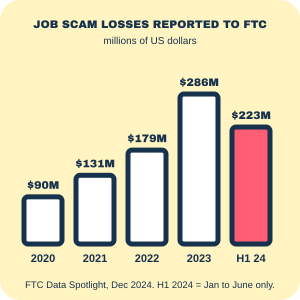 Figures from the FTC's December 2024 data spotlight.
Why Cryptocurrency Is the Currency of Choice
You may be told to buy cryptocurrency and send it to a wallet address, sometimes described as "topping up" your account. The FTC found that crypto is now the most common way victims pay in job scams, and that people report losing more money this way than by any other method. Crypto transfers are fast and hard to reverse, and the instructions can sound technical enough to make a newcomer feel they are simply following the platform's rules.
That technical feeling is part of the trap. A genuine employer pays wages into your bank account and has no reason to involve you in buying digital coins. When a job requires you to learn how to move crypto before you can earn, treat that as the cue to stop.
Three Rules for Spotting Fake Work
The first rule is to ignore unexpected job messages, especially generic ones. The second is that a real job never asks you to pay in order to start or to receive your wages, whatever the demand is called, whether a deposit or a fee. The third is that work consisting of liking and rating things for money is not genuine, whatever the app looks like.
If You Have Already Deposited
Stop paying immediately, however close the next "unlock" seems, and do not send money to recover earlier payments. Keep screenshots of the chats, the app and any transaction details, then contact your bank or the crypto platform you used. Report the scam to the FTC at ReportFraud.ftc.gov, and block the numbers that contacted you.
- US Federal Trade Commission, How to spot and avoid task scams (August 2025)
- US Federal Trade Commission, Data Spotlight: Paying to get paid: gamified job scams drive record losses (December 2024)
- US Federal Trade Commission, New FTC data show skyrocketing consumer reports about game-like online job scams (December 12, 2024)