Government Grant Scams: Why "Free Money" Offers Always Come With a Fee
 The prize is large; the fee comes first.
Free Money From an Agency You Never Applied To
The FTC explains that scammers advertise fake government grants online, call with spoofed numbers that look like federal or state agencies, or send texts, emails and social media messages saying you may qualify for free money. The promised funds cover education, home repairs, business costs or bills. The callers may impersonate a real agency, or invent an official-sounding one. AARP adds that the pitch is typically vague and gives no real eligibility criteria.
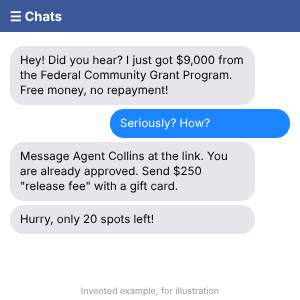 Invented example, for illustration: a friend's message, a release fee and a deadline.
Why a Friend's Message Is Not Proof
AARP reports that social media is the most common channel, often through messages that appear to come from people you know, whose accounts may have been hacked or cloned. Scammers also use spoofed caller ID, look-alike websites and search ads, and in the aftermath of floods or tornadoes they pose as FEMA or the Small Business Administration. Fake "unclaimed property" claims work the same way: you are told money is waiting, but must give your Social Security number to collect it.
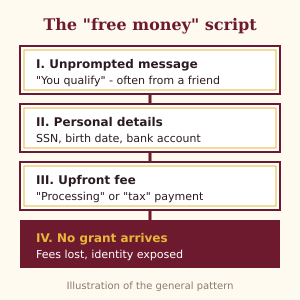 The usual script behind a grant scam.
Details and Fees They Ask For
Grants.gov lists the common types: unsolicited awards, fee-based grants, fake agencies, no-application grants, "prize" grants and unrestricted funds. The FTC says victims are asked for a Social Security number, then bank details or upfront fees, often by gift card, cash reload card, wire transfer or cryptocurrency. AARP gives examples of a $5,600 "subsidy check" claim and a $50,000 grant that required a $3,000 fee. Look-alike application sites collect Social Security numbers that can be used to take out loans in your name.
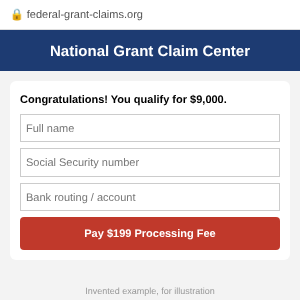 Invented example, for illustration: a .org address, personal data and a processing fee.
How Real Grants Differ
According to AARP, 52 federal agencies award grants worth over a trillion dollars a year, but real applications run from about 18 to several hundred pages and take a month or two to prepare, followed by a similar vetting period. Real grants go to organisations, governments, nonprofits, schools and small businesses rather than to individuals who simply respond to a message. Grants.gov adds that you never pay a fee for a federal grant, and the FTC notes that the official list of grants is free at grants.gov, so anyone selling a list is a warning sign. Government websites end in .gov, not .org, .com or .us.
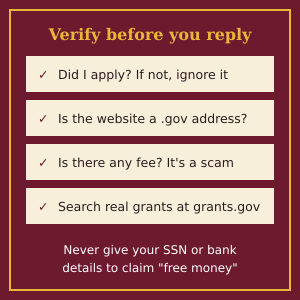 Four questions to ask before replying.
- Contact the company you used to send the money, such as the gift card or money transfer provider, and ask them to reverse it. The sooner, the better.
- Report it to the FTC at ReportFraud.ftc.gov or 877-382-4357, and to the FBI at ic3.gov.
- If you gave a Social Security number, watch your credit reports and consider a freeze.
- Ignore follow-up messages from "recovery" agents promising your fee back.