SIM Swap Scams: How Criminals Hijack Your Phone Number to Empty Your Accounts
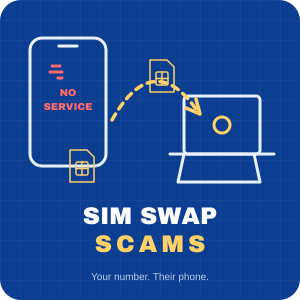 Your number moves to their phone, and your phone goes dead.
The Moment Your Phone Goes Silent
You wake up and your phone has no signal. You cannot call, text or use mobile data, and you assume it is a network fault. The US Federal Trade Commission lists exactly this as the clearest warning of a SIM swap, along with a message from your carrier saying that your SIM was activated on a new device. While you are restarting the handset, someone else is already receiving your calls and texts.
That is the whole trick. The scammer has persuaded your mobile carrier to move your number to a SIM card that they control, and from that point your phone number works on their device instead of yours.
Why a Phone Number Is a Master Key
A number may seem like a simple label, but many of your accounts treat it as proof of identity. Banks, email providers, social networks and crypto exchanges send one-time codes by text, and anyone who receives your texts can use those codes to reset passwords and log in. The FBI describes criminals requesting password resets or account recovery and then using the codes sent to the hijacked number to take over accounts.
The FTC adds that scammers can also open new accounts or buy phones in your name, and that they may lock you out by changing your passwords.
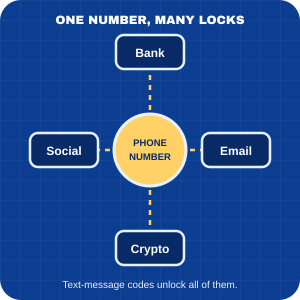 Whoever controls your number can receive the codes that open your accounts.
Three Ways In
The FBI says criminals use three main methods. The first is to impersonate the victim, telling the carrier that the phone has been lost or damaged and asking for the number to be moved to a new SIM. The second is to pay off a carrier employee to carry out the swap. The third is to phish employees of the carrier into installing malware that gives the attackers access to its systems.
A related trick, port-out fraud, moves your number to a different carrier altogether. The result is the same: your calls and texts end up somewhere you cannot see them.
Where the Scammer Gets Your Details
To sound convincing to a carrier's customer service, a criminal needs facts about you. AARP explains that these come from data breaches, phishing messages, social media and public records. A birthday, a pet's name or a school mentioned in a public post may be all it takes to answer a security question.
> scammer answers with facts from your public profile
> number moved. No Service on your phone.
When the Texts Stop, the Withdrawals Start
Once the swap happens, victims often see their accounts emptied within hours. AARP described a 74-year-old woman whose phone was hijacked while she was on holiday in South Carolina in 2021. Her bank later credited $21,916.41 that had been withdrawn without her permission. The refund was possible because the bank accepted that she had not authorised the transfers, which is not always the case.
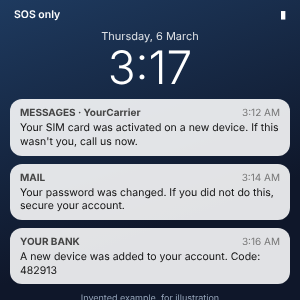 An invented example: "SOS only" and a string of alerts in the middle of the night.
The Numbers Behind the Swaps
The FBI reported that between January 2018 and December 2020 it received 320 SIM swapping complaints, with adjusted losses of about $12 million. In 2021 alone it received 1,611 complaints, with more than $68 million in adjusted losses. AARP also noted a Princeton University study from early 2020 which found that five carriers it tested used authentication methods that attackers could easily bypass.
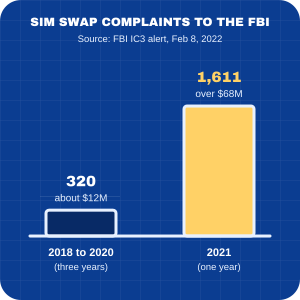 FBI figures, February 2022. Complaints, not total victims.
Text Codes Are the Weak Link
The simplest improvement is to stop relying on text messages for your most important accounts. The FTC suggests an authentication app or a security key instead of text codes, and the FBI recommends stronger multi-factor authentication such as biometrics, physical keys or standalone authenticator apps. AARP's advice is to keep two-factor authentication on rather than turn it off, but to choose an authenticator app over SMS where you can.
Locking Your Number Down
Add a PIN or passcode to your mobile account, and ask your carrier what extra protections it offers, such as a lock that blocks changes without that code. AARP also suggests setting a PIN on the SIM card itself and protecting the handset with biometrics. Give companies a landline or a free secondary number instead of your main mobile number where possible, delete emails that contain sensitive codes, and keep birthdays, pet names and school details out of public posts.
Never give your account PIN to someone who calls you. The FBI's advice is to hang up and call your carrier's customer service line yourself.
If Your Phone Dies Without Warning
Call your carrier at once, from another phone, to regain control of the number. Then change the passwords on your email, banking and other key accounts, and ask your bank to flag suspicious logins and transactions. Check your statements, report the activity to the police and the FBI at ic3.gov, and if personal details may have been stolen, follow the recovery steps at IdentityTheft.gov. AARP also suggests considering a fraud alert with the credit bureaus.
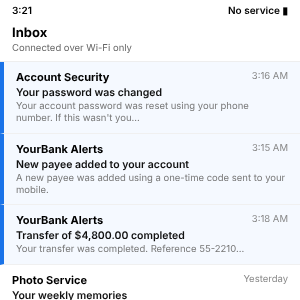 An invented example: with no mobile service, the alerts only show up on Wi-Fi.