Student Loan Relief Scams: Why You Should Never Pay for Forgiveness
 Real help with federal student loans never costs anything.
A Text About Forgiveness You Never Asked For
A message arrives saying your federal student loans qualify for a special forgiveness program, but only if you act in the next 24 hours. It may come by phone, email, text, social media or an online ad. Federal Student Aid, the US Department of Education office that runs the federal loan system, warns that scammers often pretend to be Federal Student Aid or your loan servicer, spoof caller ID and copy official logos and seals to look real.
Why Borrowers Are Easy Targets
Student debt is stressful, confusing and constantly in the news. Scammers watch that news and time their pitches to it. The FTC notes that callers follow announcements about forgiveness and claim to be checking your eligibility for a new program, and the CFPB found that some callers already knew borrowers' loan balances or recent consolidation activity, which convinced people they were talking to their servicer.
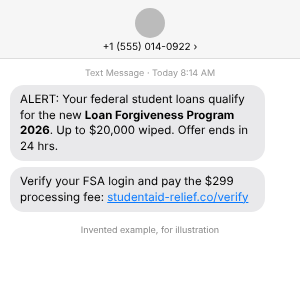 An invented example: a big promise, a countdown and a link.
Paying for Something That Is Free
The core of the scam is selling you what you can get for nothing. Income-driven repayment plans, consolidation, Public Service Loan Forgiveness and Teacher Loan Forgiveness are all free to apply for through your federal loan servicer and StudentAid.gov. The CFPB says scammers charge hundreds or even thousands of dollars for paperwork that servicers handle without a fee, and the FTC points out that companies cannot legally charge before helping reduce or eliminate student loan debt.
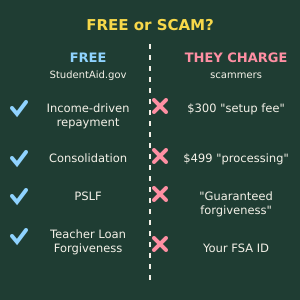 Everything on the left is free from official sources.
The Real Prize Is Your FSA ID
Some scammers care less about the fee than about your login. Federal Student Aid lists requests for your StudentAid.gov username, password or secure codes as a warning sign, including requests to approve a login you did not start. The CFPB explains why this matters: with your FSA ID, a criminal can reach your account and cut you off from your servicer, so you may never see notices about missed payments.
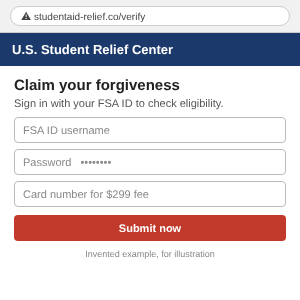 An invented example: a look-alike page asking for a login and a card number.
Stop Paying Your Servicer, Sign Here
A particularly damaging tactic is cutting you off from the people who really manage your loan. The CFPB warns that scammers may urge you to pay them instead of your servicer, or to stop talking to the servicer altogether. Some victims were asked to sign a power of attorney giving the company authority to act for them. Federal Student Aid lists instructions to stop communicating with or paying your legitimate servicer as a clear warning sign.
What the Enforcement Cases Show
This is not a small-time problem. Federal Student Aid reports that in July 2026 the FTC acted against the operators of a student loan debt-relief scheme that took more than $45.9 million from consumers.
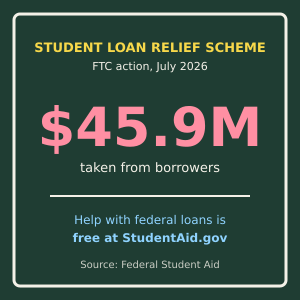 As reported by Federal Student Aid, July 2026.
Checking a Message Before You Click
Federal Student Aid says its emails come only from a short list of noreply addresses at studentaid.gov domains, and its texts come only from the short codes 227722 or 51592. Even so, the safest habit is not to use any link or phone number in the message. Go to StudentAid.gov yourself, or call the number on your servicer's billing statement. The FTC adds that FSA and your servicer will never pressure you to sign up for anything, and that the dashboard in your own account shows which programs you may qualify for.
If You Already Handed Something Over
Stop all contact and do not send more money or information. Log in to StudentAid.gov directly, change your password if you shared it, and check your contact details and two-step verification. Confirm with your servicer that nothing was changed without your permission, and cancel any power of attorney you signed. Call your bank or card issuer about any payment, then report the scam to the Federal Student Aid Feedback Center and the FTC at ReportFraud.ftc.gov. If your personal information may be misused, IdentityTheft.gov explains the recovery steps.