Brushing Scams: Why a Package You Never Ordered Is a Warning, Not a Gift
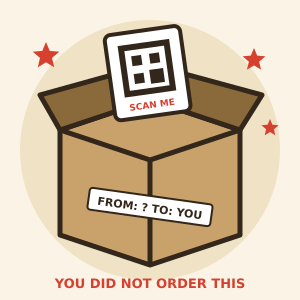 A package you never ordered is rarely a gift.
A Box on the Doorstep With Your Name on It
A parcel arrives addressed to you. You do not remember buying anything, and the sender may be an unfamiliar company or packaging that looks like a well-known retailer such as Amazon. The FTC says that recent reports describe cheap, random contents, such as baby wipes, toothpaste or seeds. It feels like a harmless freebie, but it is the visible part of a scheme with a name: brushing.
Why Would Anyone Send Free Stuff?
The point is not to give you a gift. The US Postal Inspection Service explains that brushing is often carried out by third-party sellers who found your address online. Once the parcel is delivered, the seller has a confirmed "purchase" to a real person and writes a fake review in your name. The FTC describes the same pattern: confirm a delivery to a real person, then post glowing reviews to boost the seller's sales. Because the goods are cheap to make and ship, the trick stays profitable.
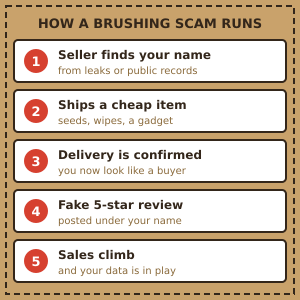 Your address becomes the proof that a product has real buyers.
The Review You Never Wrote
The result is a five-star review with your name next to it, often marked as a verified purchase. Other shoppers trust it, and some of them end up buying a worthless product. Massachusetts consumer officials point out that these packages often mimic big retailers but lack a valid return address, which is a clue that something is off.
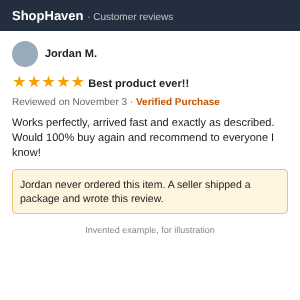 An invented example: a glowing review for something the person never ordered.
When a Card in the Box Wants You to Scan It
Some parcels now contain a note or card with a QR code that promises to reveal who sent the package or to arrange a return. The FTC warns that scanning it can lead to a phishing site that steals credit card numbers, usernames or passwords. The Postal Inspection Service calls this newer variant "quishing". A parcel that you did not order should never be a reason to scan a code from inside it.
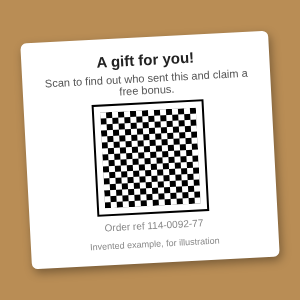 An invented example: a "gift" card with a QR code.
What the Package Says About Your Data
The FTC notes that an unexpected package may signal that someone already has your personal information or is trying to get it. Postal inspectors add that scammers may use your address and account details to redirect merchandise and steal it before you receive it. That makes a mystery box a good moment to check your own accounts.
Keep It, Return It or Bin It
You are under no obligation to pay for unsolicited goods, and the Postal Inspection Service says you may keep them. Be cautious about using the items, since you do not know who sent them. If the package is unopened and has a return address, you can mark it "Return to Sender" and the Postal Service returns it at no charge. If you opened something you do not want, it is safe to throw it away. If the contents are an unknown liquid, an organic material or a substance, contact the proper authorities and follow their instructions.
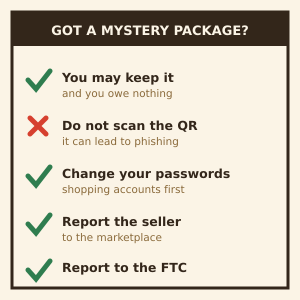 A short checklist for the next mystery box.
Tidying Up After a Mystery Delivery
Change the passwords on your online shopping accounts in case they were compromised, and watch your card statements and credit reports. The FTC points to free weekly reports at AnnualCreditReport.com. If the package came through Amazon, eBay or another marketplace, report it to the platform so it can investigate the seller and remove any review written in your name. You can also report brushing to the FTC at ReportFraud.ftc.gov, and report suspicious mail to the Postal Inspection Service on 877-876-2455.