Don’t Fall for It: The Online Dating Travel Scam
Female Dating Scams: “She Wants to Visit You”
The travel-based romance scam is one of the most emotionally manipulative and financially damaging schemes in online dating. Because it can lead to large payouts, scammers are willing to invest weeks—or even months—building trust and appearing completely genuine.
Single men who use online dating platforms are especially vulnerable to this tactic, often without realizing they are being targeted until the damage is already done. The amount of time and effort these scammers put into the deception is significant—and sadly, very effective.
How the Travel Scam Begins
One of the earliest warning signs is an influx of frequent, detailed messages. These messages tend to be long, thoughtful, and emotionally engaging, carefully designed to make the recipient feel special and deeply valued.
As time goes on, communication intensifies. She begins messaging every day, sometimes multiple times a day, creating the impression that she is always online and fully focused on the relationship.

Gradually, the tone becomes more romantic. The scammer puts considerable effort into crafting affectionate and emotionally charged messages to strengthen the bond and deepen emotional attachment.
This stage can last weeks or even months. The scammer is patient, waiting until she believes the victim is emotionally invested enough to send money.
The “Travel Opportunity” Story
Once trust has been established, the travel scenario is introduced. While the story may differ slightly, it usually includes one or more of the following claims:
- She has unexpectedly been given a two-week holiday, making it the perfect (and urgent) time to visit
- A friend or family member works at a travel agency and can arrange a special deal
- Her passport is close to expiring, meaning this is her only chance to travel right now
The purpose is to create urgency. The victim is made to believe this is a rare opportunity that must be acted on immediately if they want to meet in person.

The Request for Money
Shortly after the travel story is introduced, the request for money follows. She may say she needs help covering expenses such as:
- Visa fees
- Airline tickets
- Travel insurance
- Unexpected or last-minute travel costs
She emphasizes that the money is needed right away, reinforcing the pressure to act quickly.
Under normal circumstances, a request for money from someone met online should immediately raise concern. However, because the scammer has already built a strong emotional connection, many victims overlook the warning signs.
As a result, countless men send money and fall victim to this scam.
Disappearance—or the Second Phase
In many cases, once the money is sent, the scammer vanishes without warning, cutting off all communication entirely.
In other cases, the scam continues.
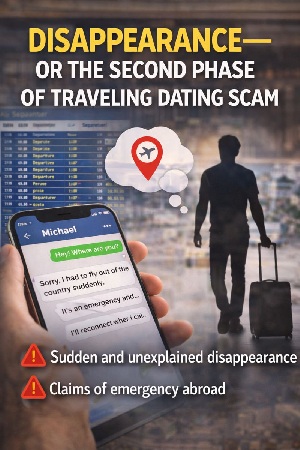
If the victim has already sent money once, the scammer may attempt to extract even more. She remains in contact and claims everything is progressing— perhaps the visa is approved or the ticket has been booked.
Then, another problem suddenly appears.
This begins the second phase of the scam, where additional money is requested due to:
- Visa complications
- Unexpected travel delays
- Extremely expensive last-minute airfare
No matter the excuse, the objective is always the same: to get more money.
How the Scam Ends
Eventually, when the victim realizes she is never going to arrive, the payments stop. At that point, the scammer disappears permanently—often having taken a significant amount of money.
Final Warning
If someone you have never met in person asks you to send money so they can travel to see you, it is a serious red flag. Genuine relationships do not require financial support from strangers.
Understanding how the travel scenario scam works is one of the most effective ways to protect yourself from becoming its next victim.