Car warranty scams: why a recorded call about your "expiring" warranty is a trap
"We've been trying to reach you about your car's warranty"
Few scams are as familiar as the car warranty call. The FTC describes how it usually goes: you answer and hear a recorded message about your vehicle's manufacturer warranty. It says you have been sent mail notices, that your warranty is not extended past the factory cutoff, and that your file will close unless you respond. It asks you to press one number to renew and another to be removed from the list.
The FTC calls these calls illegal and likely scams, and says the callers are not connected to your car dealer or manufacturer. AARP adds that scammers may also mail fake expiration notices that look official, and may know your car's make and model because that information is publicly available, which makes the pitch more convincing.
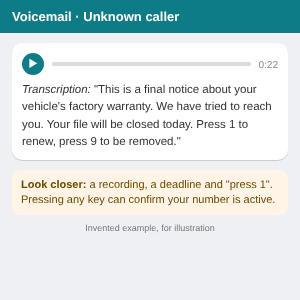 Invented example, for illustration: a recorded message with a deadline and a key to press.
What you are really being sold
The "extended warranty" is actually a service contract, and the FTC notes it often costs hundreds or thousands of dollars. Restrictions in the fine print may mean the contract does not cover the problems you actually have. AARP's key rule is that only your manufacturer can extend a factory warranty, so an outside company making that offer is a warning sign. As it puts it, "Any unsolicited warranty offer is almost certainly a scam."
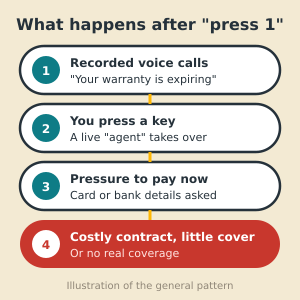 The usual sequence after you press a key on the call.
Why pressing a key is a mistake
Pressing "1" connects you to a live "salesperson" who wants your payment details. Even pressing the key to be "removed" can tell the caller that your number is active, according to AARP. The FTC's advice is to hang up and not engage with a company that reaches you through an illegal call.
The FCC took action as well. On July 21, 2022 it ordered all U.S. voice service providers to block all auto warranty robocall traffic. Even so, readers of the FTC's own alert reported that calls kept coming from new, sometimes spoofed, numbers, so the habit of hanging up still matters.
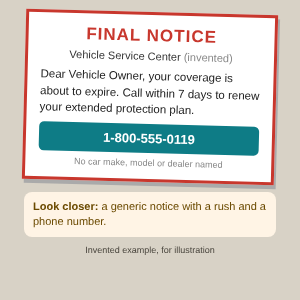 Invented example, for illustration: a generic notice that names no car, no dealer and no real company.
How to protect yourself
Hang up, and if you want to check on your coverage, call the dealership using the number on its website or your purchase paperwork. Do not trust caller ID, since scammers can spoof names and numbers. Never share payment or license details until you have verified the company yourself. The FCC says not to share your Social Security number, credit card, driver's license or bank account details unless you can verify that you are dealing with a legitimate company you already do business with.
If you do want extra coverage, check the manufacturer's warranty terms first, then consider established providers such as your automaker, and read the contract carefully. AARP also quotes an auto expert who says extended warranties are rarely worth the cost and suggests saving that money for future repairs.
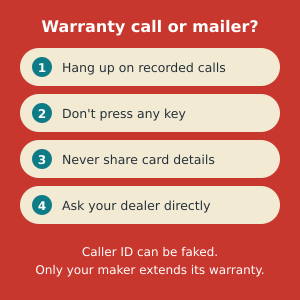 A quick checklist for a warranty call or mailer.
- Contact your bank or card issuer at once, using the number on your card, and ask about disputing the charge and replacing the card.
- Keep any contract, receipt and the number that called you, and read the contract for cancellation rights.
- Report the call at DoNotCall.gov, to the FCC's Consumer Complaint Center, and to the FTC at ReportFraud.ftc.gov.
- Consider an app or service that blocks unwanted calls.