Fake Customer Service Number Scams: When the First Search Result Connects You to a Scammer
 The top result is not always the real company.
When Help Is One Search Away
When something goes wrong, such as a cancelled flight, a missing refund or a locked account, people search for a phone number and call the first one they see. AARP explains that criminals take advantage of this by luring people into calling fake support numbers for payment apps and retailers, with Amazon an especially common disguise. The person who answers sounds helpful, then steals money or personal data. AARP notes that the FTC ranks impostor scams as the most commonly reported scam type in the United States.
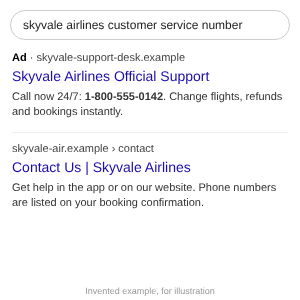 Invented example, for illustration: the paid ad sits above the genuine result.
How the Fake Number Finds You
The FTC warns that scammers sometimes buy paid search ads imitating a legitimate business or agency, listing their phone number beside a trusted name or linking to an official-looking site. AARP lists more routes: phishing emails that warn of fraud on a payment app and demand a call within 24 hours, texts claiming a package is lost, look-alike websites ranking at the top of results, social media replies posing as company staff, and even hacked message boards that recommend fake call centres. Complaining publicly can invite this, because scammers monitor forums and answer with false contact details.
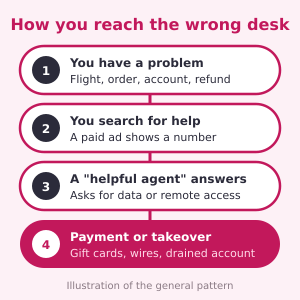 How a real problem leads to the wrong phone.
What the "Agent" Wants
The FBI's Internet Crime Complaint Center describes impostors posing as support for banks, utilities, cryptocurrency exchanges and rideshare services, citing pretexts like a compromised account, a virus or a software renewal. Victims are pushed to wire money overseas, buy prepaid cards or pay in cryptocurrency, including through crypto ATMs. In banking versions, the caller gains remote access to a computer and the bank account, then moves funds out. Travel versions involve fake car rental, airline or hotel reservations, often paid with prepaid cards.
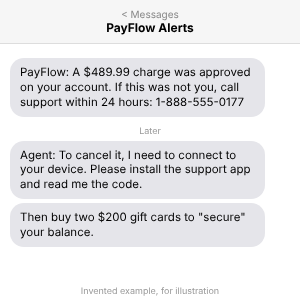 Invented example, for illustration: an alert, then remote access, then gift cards.
Warning Signs During the Call
AARP points to unsolicited messages demanding that you contact customer service right away, look-alike web addresses, an "agent" who asks for personal information, unusual payment requests such as gift cards or cryptocurrency, and any request to install an app that gives remote access to your device. The FBI adds that legitimate companies do not contact people unsolicited, so any pressure to act immediately should be treated as a red flag.
Finding the Real Number
The FTC advises scrolling past paid results, typing the company's web address into your browser, or calling the number on your bill. AARP recommends taking phone numbers only from the company's official site, never from links in texts or emails, and contacting an airline through its app after you log in. The FBI suggests ad blockers and up-to-date security software, and never giving unverified people remote access.
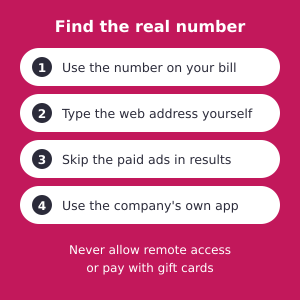 Four ways to reach the real company.
- Hang up, and do not install anything or read out any codes.
- If you gave remote access, run a virus scan and change your passwords from a clean device.
- Contact your bank or card issuer straight away and ask them to monitor or block transactions.
- Report it at ReportFraud.ftc.gov and ic3.gov, with the number, links and payment details. Expect more contact attempts, as scammers can share victim lists.