Fake Online Store Scams: How to Spot a Shopping Site That Never Delivers
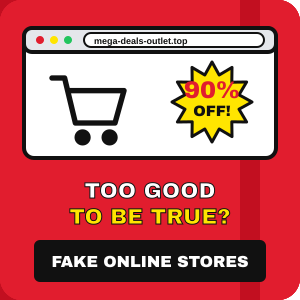 A huge discount is often the first sign of a fake shop.
A Bargain That Slid Into Your Feed
The first contact with a fake shop is rarely a search. It is an advert that appears while you are scrolling, showing a laptop, a sofa or a pair of trainers at a price that makes you stop. The Better Business Bureau and the FDIC have warned that scammers pay for social media adverts that offer steep discounts, and the FBI has described fake shops that also climb into search engine shopping results.
The pitch often comes with a story, such as a "closing-down sale" or a clearance "while stock lasts", which gives you a reason to hurry. Norton notes that these adverts can even use AI-generated images, and scammers run many versions at once to see which one works best.
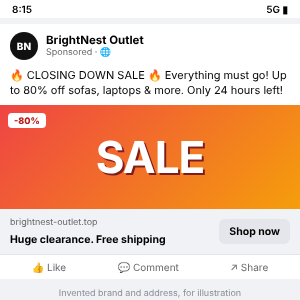 An invented example: a sponsored post for a "closing-down sale".
Borrowed Logos and Look-Alike Addresses
Behind the advert sits a storefront built to look familiar. According to the BBB, fake shops copy a real retailer's logo, layout and product listings, and some use web addresses that differ from the genuine one by only a letter or two. In 2023, the BBB reported, scammers built look-alike Bed Bath and Beyond sites and ran adverts for fake going-out-of-business sales, and the shoppers who paid received nothing.
Not every fake copies a big name. Norton says some copy the photographs and text of small independent sellers, and the FBI found sites that displayed American addresses and phone numbers unrelated to the shop, with several unconnected "retailers" listing exactly the same contact details.
What Arrives, If Anything
Sometimes nothing arrives at all, and the money and your card details are simply kept. In other cases the package is a disappointment. In the cases the FBI described in 2020, shoppers who thought they were buying gym equipment, tools or furniture received cheap disposable face masks shipped from China. When they complained, they were offered partial refunds, told to keep the item, or asked to send it back overseas at their own expense, and the FBI said that every attempt to obtain a full refund failed.
Counterfeit goods carry another risk. The BBB, citing the US Consumer Product Safety Commission and the US Chamber of Commerce, notes that fake electronics and other products can overheat or malfunction.
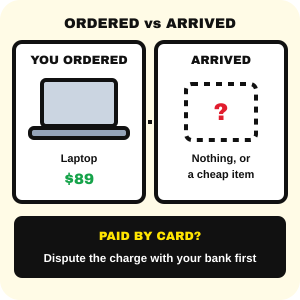 What you order and what turns up can be very different things.
Reading a Website Like a Detective
A few minutes of inspection will catch most fakes. Start with the address. The FBI observed that many fake shops use endings such as ".club" or ".top" rather than ".com", and that the domains had often been registered within the previous six months. A free WHOIS lookup shows when a domain was created, and a registration hidden behind a privacy service on a brand-new site is another worry.
Next, look at the page itself. Be suspicious of a catalogue that sells everything and is never out of stock, review badges that cannot be clicked, a missing or vague "About" page, and the absence of any contact details, privacy policy or return policy. Blurry photographs and spelling mistakes also count. Check the shop's phone number, email and address too, since a company using a free email account is not what it seems.
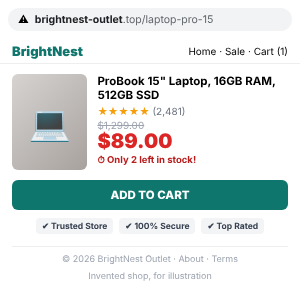 An invented example: a ".top" address, a huge discount and pressure to hurry.
Trust Badges and Five-Star Reviews
Fake shops try hard to look trustworthy. Norton warns about logos of third-party review platforms that cannot be clicked or verified, and scammers may fill a page with glowing comments and "Trusted Store" seals that mean nothing. A better test is to search the shop's name together with words such as "complaints", "not delivered" or "scam", and to read reviews on independent sites and social media rather than on the shop's own pages.
How Big the Problem Has Become
Norton reported in April 2025 that its systems detected more than 1,000 new fake online shops every day. That figure comes from the company's own research, but it fits what consumer groups say. Norton also cites FTC and BBB data placing fake shops among the three most financially damaging online scams.
Pay With the Card, Not the Cash
How you pay may decide whether you get your money back. The FBI's victims paid through an online money transfer service, which left them with little protection. The BBB and Norton both recommend using a credit card, because it usually offers stronger fraud protection and easier disputes than a debit card or a bank transfer. Be wary if the site pushes you towards wire transfers, cryptocurrency or gift cards after a "payment error".
When the Parcel Never Comes
Contact your card issuer or bank straight away and dispute the charge. Norton says chargeback windows are typically 30 to 120 days, and PayPal gives 180 days for disputes, so do not wait. Speak to the shop only after you have contacted your payment provider, because fake shops often stall. The FBI also urges victims to ask their bank to contact the receiving institution.
Then report it: to the FTC at ReportFraud.ftc.gov, to the FBI's IC3 at ic3.gov, and to the BBB Scam Tracker. Because your card details were entered on a scammer's page, watch your statements for unfamiliar charges and ask your bank whether you should replace the card.