Wrong Number Text Scams: Why a Stranger's "Oops" Is Never Really a Mistake
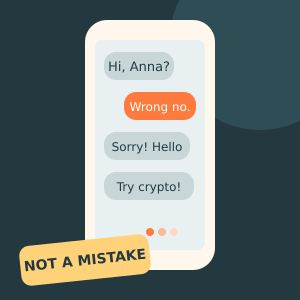 The mistake is the message itself.
A Message Meant for Someone Else
The text arrives from a number you do not know. It might ask whether you are still on for dinner, whether you are interested in touring a property, or simply say "Hi, how are you?". The FTC notes that if you answer, the sender apologises, then keeps the conversation going to build trust. AARP lists other openers too: an urgent request to book a vet appointment for a sick dog, a note meant for a yoga instructor, or a plain "Have I missed your call?". None of it is an accident. The first message is often automated and sent to huge lists of numbers.
Why Even a Polite Reply Matters
Massachusetts consumer officials explain that replying, even to say it is the wrong number, marks your number as active and makes you a target. AARP adds that replying "STOP" does the same. For scammers, that single answer is worth more than the message cost them. Robokiller counted 19.2 billion spam texts in April 2025, about 63 per person in the United States, so the volume the scheme can afford is enormous.
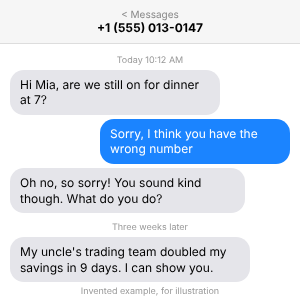 Invented example, for illustration: a polite mistake turns into a friendship and then a pitch.
Weeks of Friendship, Then the Pitch
Once you reply, the sender builds rapport, sometimes as a friend, a mentor or a romantic partner, often with borrowed photos and invented life stories. AARP reports that organised teams run these chats, including one operation in Cambodia using a fictional persona built on a stolen identity. Eventually the talk turns to money: cryptocurrency investing or "secrets" to making big money, often for a fee. The FTC warns that anyone guaranteeing large returns quickly with no risk is a scammer. Massachusetts officials also describe a romance variant, where the person pretends you are a date, then asks for personal details or compromising photos and may use them for blackmail.
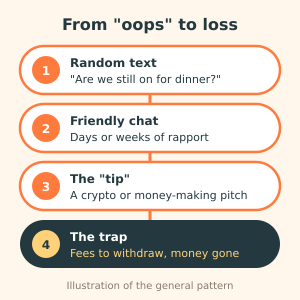 The common path from a stray text to a loss.
The Withdrawal That Never Comes
The investment account looks real, with a balance that keeps rising. Trouble starts when you try to withdraw: AARP says victims are told they must first pay taxes. Paying does not release anything; it simply adds to the loss. Some victims lose hundreds of thousands of dollars. The scheme is closely related to the long-con pattern we cover in our guide to pig butchering.
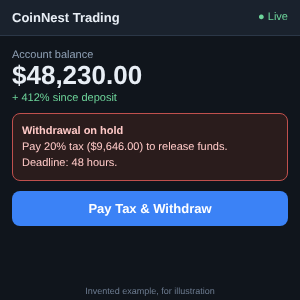 Invented example, for illustration: a big balance you can never withdraw.
What to Do With a Text From a Stranger
The FTC's advice is simple: do not reply to texts from unknown numbers, and do not click links in unexpected messages, since they can steal information or install malware. AARP adds that shortened links hide their destination. Having your name or number does not mean someone knows you, and you should never share personal or financial details with someone you know only from texts.
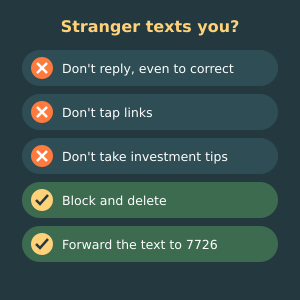 Three things to avoid, two to do.
- Stop the conversation and block the number.
- Forward the text to 7726 (SPAM) so your carrier can look into it.
- If you sent money or details, report it at ReportFraud.ftc.gov and at ic3.gov.
- Do not pay any "tax" or "release fee" to get your money back.