Fake escrow scams: why a seller who picks the "safe" payment service is part of the scam
When "protection" is the trap
Escrow is a legitimate idea: a neutral third party holds the buyer's money until the item arrives as promised. Scammers borrow that trust. In a fake escrow scam, both the deal and the escrow company are fake. A seller who cannot meet in person suggests a "safe" escrow or shipping service, and the buyer's payment goes straight to the scammer.
The Better Business Bureau's 2020 investigation focused on vehicles. Fake sellers advertise cars, trucks, vans and RVs at very low prices on sites such as Craigslist, then offer delivery if the buyer pays through escrow. The vehicle and the escrow company are both fake, so the buyer loses the money and gets nothing.
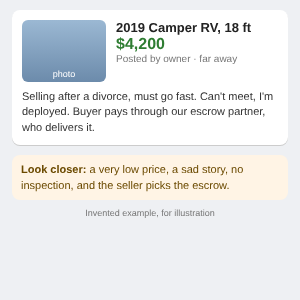 Invented example, for illustration: a low price, a sad story and an escrow chosen by the seller.
How the scam is dressed up
The BBB lists common tactics: prices much lower than market value, sad backstories such as a military deployment, divorce or a relative's death, refusal to allow an in-person inspection, payment by wire transfer to a supposedly independent company, and pressure to pay within a short deadline, in one case two hours. Bogus escrow websites may use the names and addresses of real businesses.
The Minnesota Attorney General adds that scammers may pose as well-known companies, send official-looking emails with real logos, and ask the buyer to pay with gift cards or wire transfers. Money sent that way is very hard to trace and nearly impossible to recover.
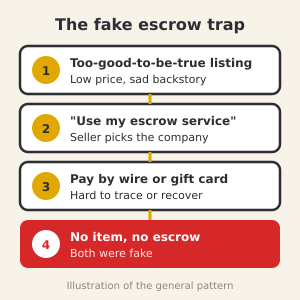 The usual sequence, from the listing to the missing item.
How to check an escrow company
California's Department of Financial Protection and Innovation (DFPI) offers ten tips. It advises confirming that an escrow company is licensed, being suspicious if a buyer or seller insists on one particular escrow company, and avoiding sites with no address or phone number. When you call, you should reach a live person, because "a generic voice mail is a sign that the company may be fraudulent." It also warns that fake sites may display trust seals, so logos alone prove nothing.
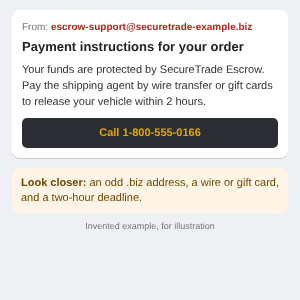 Invented example, for illustration: an odd email address, a wire or gift card payment and a short deadline.
A real escrow company processes the transaction itself. DFPI says legitimate escrow companies do not use person-to-person transfers such as Western Union or MoneyGram, and do not send you to pay an individual. The department also says scam escrow sites often lure people with unrealistically low prices in online classifieds or auctions. Check the sender's email address too: if it does not match the company's real domain, delete the message without clicking anything.
Smarter ways to buy
Inspect the item in person where you can, and walk away from anyone who refuses. Pay by credit card or through a secure payment site rather than by wire or gift card. If a seller pushes a specific escrow service, treat that as a warning and pick your own, after verifying its license and contact details yourself.
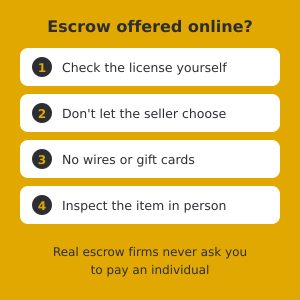 A quick checklist before using an escrow service you were told about.
- Contact your bank immediately to report the wire or payment and ask whether it can be stopped or recalled.
- Keep the listing, emails, receipts and any account details you were given.
- Report it to the FBI's Internet Crime Complaint Center (ic3.gov), the FTC and the BBB Scam Tracker, and report the ad to the platform where you found it.
- Do not pay any further "fees" or "taxes" to get the money back.